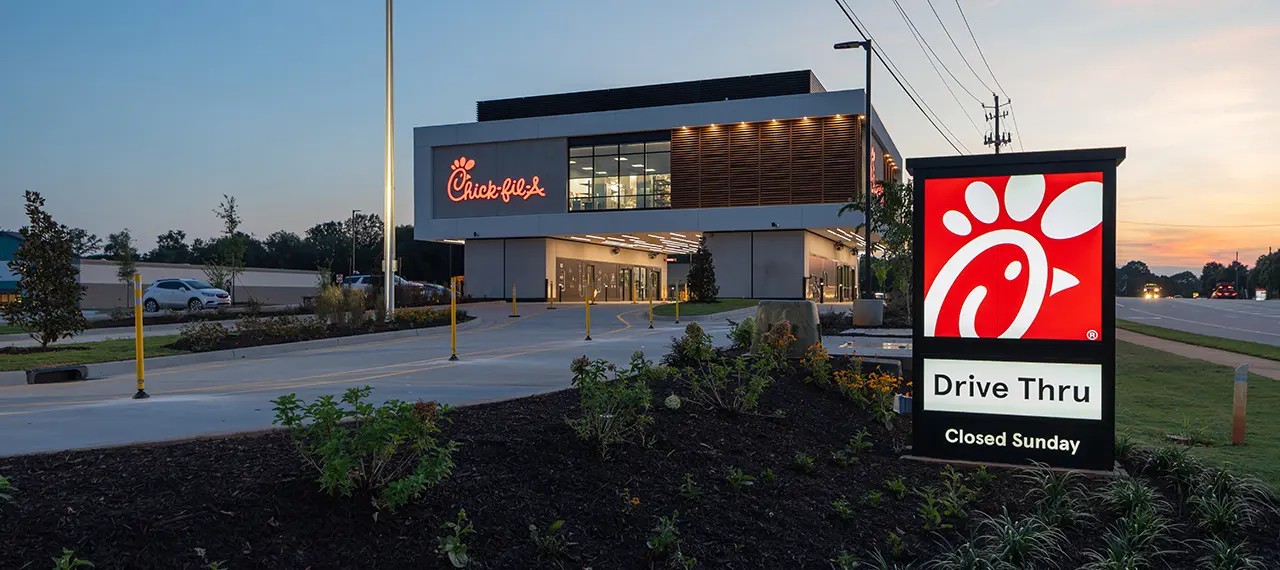
Chick-fil-A & BVNA Centralize 3,000+ Construction Projects With Quickbase
The Client Profiles: Chick-fil-A & Bureau Veritas North America (BVNA)
Industry: Construction, Engineering, Quick-Service Restaurants (QSR), Commercial Real Estate
Client: Chick-fil-A & Bureau Veritas North America (BVNA)
Project: Enterprise Construction Portfolio Management & Nationwide Restaurant Infrastructure Modernization
Technology: Quickbase, Low-Code Application Development, Workflow Automation, Data Migration & Construction Project Management
Use Case: Centralized Construction Project Tracking, Automated Milestone Forecasting, Contractor Coordination, Approval Management & Enterprise Portfolio Visibility
Chick-fil-A & Bureau Veritas North America
Chick-fil-A is one of the largest quick-service restaurant (QSR) brands in the United States, operating thousands of restaurant locations nationwide. Known for its customer service, operational efficiency, and high-volume drive-thru operations, Chick-fil-A continues to invest in restaurant development, facility modernization, and infrastructure improvements to support its extensive footprint.
Managing construction, renovations, and operational upgrades across a nationwide restaurant network requires sophisticated project coordination, standardized processes, and real-time visibility.
Supporting these initiatives is Bureau Veritas North America (BVNA), part of the global Bureau Veritas organization, which specializes in testing, inspection, certification, and technical consulting services, including construction oversight, project management, and infrastructure assessment.
As Chick-fil-A's nationwide construction and modernization initiatives expanded, coordinating thousands of simultaneous projects became increasingly complex. Working across multiple stakeholders, contractors, locations, and approval processes required a more scalable approach to construction portfolio management.
Chick-fil-A and BVNA engaged Quandary Consulting Group to develop a centralized, Quickbase-powered construction management solution capable of supporting more than 3,000 projects across the restaurant network. B
y modernizing project tracking, automating milestone dependencies, streamlining approvals, and improving visibility into construction schedules and operational risks, Quandary helped establish a connected and scalable foundation for managing large-scale restaurant infrastructure investments.
The Challenges
Managing More Than 3,000 Construction Projects Created Significant Operational Complexity
Chick-fil-A's nationwide restaurant improvement initiatives required coordinating more than 3,000 construction projects, including drive-thru upgrades and location-specific improvements.
Each project involved a combination of construction milestones, permitting requirements, contractor responsibilities, architectural considerations, internal approvals, and operational deadlines.
Although individual locations followed similar development processes, actual project conditions varied considerably. A permitting delay at one location could require a different response than an architectural conflict, contractor scheduling issue, or delayed executive approval at another.
This created several operational challenges:
- Managing thousands of concurrent construction projects across geographically dispersed locations.
- Coordinating contractors, project managers, vendors, and internal stakeholders.
- Tracking construction milestones and task dependencies.
- Identifying delays before they affected downstream activities.
- Maintaining accurate project forecasts as site conditions changed.
- Standardizing reporting and approval processes across locations.
- Providing executives with reliable portfolio-level construction visibility.
The organization needed more than a system for recording project statuses. It needed a scalable construction management platform capable of coordinating the operational decisions required to move projects forward.
An Existing Quickbase Application Could Not Support the Expanding Construction Portfolio
Before engaging Quandary, the construction program had successfully piloted a Quickbase application to support a smaller initiative.
While the initial application demonstrated the potential of low-code construction management, the system became increasingly difficult to maintain as the program expanded.
Workflows that performed adequately for a limited number of locations were no longer reliable when applied across thousands of projects.
Manual processes became bottlenecks, milestone relationships were inconsistently maintained, and project teams struggled to identify which activities required attention.
As the volume of active projects increased, the limitations became more consequential.
A missed dependency or incomplete project record could affect multiple downstream milestones. Delayed approvals could slow construction schedules, while inconsistent data made it harder for leadership to understand the true status of the broader portfolio.
Chick-fil-A and BVNA needed to move beyond the original application and establish an enterprise-ready construction management environment.
Fragmented Construction Data Limited Portfolio Visibility
Construction portfolio management depends on the ability to connect information across project schedules, contractor activities, permits, approvals, and historical records.
The existing project environment contained inconsistent legacy data and relied on disconnected processes, also nine legacy platforms contributing to the broader information environment.
Without a consistent source of truth, construction teams faced challenges reconciling project information and maintaining reliable reporting.
This fragmentation made it more difficult to:
- Compare project performance across locations.
- Identify overdue milestones and unresolved dependencies.
- Understand which sites required immediate intervention.
- Analyze recurring construction delays.
- Evaluate contractor performance.
- Provide leadership with consistent portfolio reporting.
A centralized construction data model was necessary to improve the reliability of both daily project execution and enterprise-level decision-making.
Incomplete Milestone Dependencies Made Construction Forecasting Unreliable
Construction projects rarely progress through a series of completely independent tasks.
- Permits must be approved before certain work begins
- Architectural changes can affect contractor schedules
- Site inspections may determine whether subsequent construction phases can proceed.
In the existing environment, critical task relationships were not always consistently documented:
Some predecessor fields were incomplete or missing, asking for the information in a way that would not translate, making it difficult for the application to accurately calculate milestone sequences; and , without reliable dependency logic, construction forecasts could become disconnected from actual project conditions.
A delayed activity might not automatically update the projected completion dates of dependent tasks, forcing project managers to manually identify and communicate schedule changes.
For a construction portfolio involving thousands of projects, this created significant administrative work and increased the risk of overlooked delays.
Manual Approvals and Escalations Slowed Construction Execution
Managing a nationwide construction rollout requires frequent coordination between field teams, program managers, and executive stakeholders.
The existing process depended heavily on manual follow-up to identify approvals, update project records, and escalate construction issues; and, as project volumes increased, these activities became increasingly difficult to manage consistently.
Permitting delays, architectural conflicts, and stalled dependencies could remain unresolved until a project manager manually identified the problem.
The organization needed automated workflows capable of recognizing project conditions, initiating the appropriate next step, and directing issues to the responsible stakeholders.
The Solutions
Quickbase Became the Centralized Construction Portfolio Management Platform
Quandary Consulting Group designed and developed a custom Quickbase application to coordinate construction project management across Chick-fil-A's nationwide restaurant improvement program.
Rather than replacing every construction process with a rigid, standardized workflow, the application was designed to accommodate location-specific requirements while maintaining consistent project governance.
Quickbase served as the central operational environment for managing construction phases, project milestones, dependencies, approvals, and site-level information.
The solution connected previously fragmented activities into a more coordinated construction management process.
The core workflow became: Construction Project Intake → Site Planning → Milestone Definition → Task Assignment → Approval Management → Construction Execution → Issue Escalation → Project Completion
By centralizing these activities, Quandary established a consistent framework for managing projects across the portfolio.
Project teams gained a clearer view of required actions, while leadership gained more reliable information about construction progress and operational risks.
Automated Milestone Forecasting Connected Project Dependencies
One of the most important components of the Quickbase implementation was the development of dynamic construction milestone forecasting.
Traditional project tracking often depends on manually updating estimated completion dates; however, when construction tasks are interdependent, changing one milestone can affect several downstream activities.
Quandary configured the application to recalculate projected milestone dates based on actual task completion and established dependencies.
When a task was completed or delayed, the system could use the updated information to inform subsequent milestone forecasts.
The forecasting workflow became:
Task Status Updated → Dependency Evaluated → Milestone Forecast Recalculated → Project Timeline Updated → Potential Delay Identified
This approach gave construction teams a more reliable understanding of how project conditions affected schedules.
Instead of relying entirely on manual reviews, project managers could use the application to identify activities that threatened downstream construction milestones.
For Chick-fil-A and BVNA, this created a stronger foundation for proactive construction scheduling and portfolio-level risk management.
Nationwide Project Batching Streamlined Executive Approvals
Coordinating approvals for thousands of restaurant construction projects created another operational challenge.
Quandary introduced a structured project batching process that grouped participating restaurant locations for coordinated executive review and approval.
This allowed stakeholders to evaluate related projects within an organized approval framework rather than managing every request through disconnected communications.
The approval workflow became:
Identify Participating Locations → Create Project Batch → Consolidate Project Information → Submit for Executive Review → Record Approval → Advance Construction Activities
Project batching helped establish a more consistent process for managing construction initiatives across multiple locations and also supported better alignment between portfolio planning, executive decisions, and downstream project execution.
Automated Task Creation Reduced Manual Project Coordination
Successful construction projects require teams to complete activities in the correct sequence; i.e., when one phase is completed, the next task may need to be assigned, an approval requested, or another stakeholder notified.
Quandary configured Quickbase workflows to automate these transitions based on project activity and predefined business rules.
For example, when a project record was updated, the application could initiate the next required action without waiting for a project manager to manually coordinate the process.
These workflows supported:
- Automated task generation.
- Assignment of responsibilities.
- Milestone deadline management.
- Approval notifications.
- Project status updates.
- Escalation of overdue activities.
The workflow became:
Project Activity Updated → Business Rule Evaluated → Next Task Created → Responsible Stakeholder Assigned → Deadline Tracked → Completion Recorded
By embedding construction process logic directly into the application, Quandary reduced reliance on manual follow-up and created more consistent execution across the portfolio.
Proactive Issue Escalation Improved Construction Risk Management
Construction delays often begin as relatively small operational issues; i.e., a missing permit, unresolved architectural question, or overdue approval can eventually affect contractors, site readiness, and planned completion dates.
Quandary developed automated escalation capabilities to identify project conditions requiring additional attention.
The application could now flag risks such as permitting delays, architectural conflicts, stalled dependencies, and overdue activities.
Which meant that now, instead of requiring teams to discover every issue through manual project reviews, the system provided a more structured method for surfacing potential problems.
The escalation workflow became:
Project Condition Detected → Risk Identified → Escalation Rule Applied → Responsible Team Notified → Corrective Action Tracked → Project Status Updated
This allowed project managers to prioritize exceptions rather than spending equal amounts of time reviewing every active project.
For a nationwide construction portfolio, the ability to distinguish routine project activity from issues requiring intervention was particularly important for the bottom line.
Construction Data Migration Established a More Reliable Source of Truth
Workflow automation is only as reliable as the data supporting it.
During implementation, Quandary identified inconsistencies in legacy construction records, including missing task relationships and incomplete predecessor information.
These issues would have completely undermined the new application's ability to calculate project schedules and enforce workflow dependencies.
Quandary worked with project stakeholders to review existing records, correct inconsistencies, and establish more reliable data relationships.
Custom scripts supported the restructuring, cleaning, and migration of historical project information, including permits, contracts, and construction records.
The data modernization process included:
- Assess existing construction data and identify inconsistencies.
- Review project milestones and predecessor relationships.
- Clean and standardize legacy records.
- Restructure data to support the new Quickbase application.
- Import historical construction information.
- Validate migrated records and workflow dependencies.
This work created a more dependable information foundation for automated milestone forecasting, project reporting, and operational decision-making.
Centralized Project Visibility Improved Cross-Functional Collaboration
Construction programs of this scale involve stakeholders with different responsibilities and information requirements.
- Field teams need visibility into immediate tasks and site-level issues.
- Project managers need to understand milestones, dependencies, and contractor activity.
- Program leadership needs a broader view of schedules, delays, and portfolio performance.
Quandary's Quickbase solution brought these operational perspectives together through centralized project records and standardized status information. Rather than relying on disconnected spreadsheets and manual reporting, stakeholders could work from a common project management environment.
This improved the ability to coordinate activities across construction teams while giving leadership greater insight into project conditions across the nationwide portfolio.
User Testing and Workflow Validation Supported Enterprise Deployment
Developing a scalable construction management application required more than configuring technical features, the system needed to reflect how construction teams actually worked.
Quandary followed a structured six-month implementation process, beginning with approximately two months of discovery.
During discovery, the team collaborated with project stakeholders to document construction phases, approval requirements, task dependencies, and escalation processes.
Process diagrams and user flows helped translate these requirements into application logic; and, following development, stakeholders tested the application using real-world construction scenarios.
This allowed Quandary to identify usability issues, refine automation logic, and validate workflows before deployment.
The resulting application combined low-code flexibility with business processes designed specifically for a large-scale construction portfolio.
The Results
Quandary's Quickbase implementation provided Chick-fil-A and BVNA with a centralized and scalable approach to managing nationwide construction operations.
By bringing project milestones, approvals, task dependencies, site information, and escalation workflows into a common application, the engagement addressed several operational limitations associated with the previous environment.
The solution drastically improved visibility into construction progress, supported earlier identification of project delays, and reduced dependence on disconnected tracking methods.
More importantly, it established an operational foundation capable of supporting thousands of concurrent construction activities without requiring every project decision to be coordinated manually.
3,000+ Construction Projects Managed Through One Application
Quandary's custom Quickbase platform centralized tracking for more than 3,000 construction projects, giving stakeholders a consistent environment for managing construction milestones, site statuses, and operational dependencies.
This supported more coordinated project execution across a nationwide restaurant improvement program.
600 Active Construction Sites Supported
The published project results identify 600 active construction sites managed within the broader construction portfolio.
Centralized project records helped teams monitor site-level activity while maintaining visibility into the larger program.
9 Legacy Platforms Consolidated Into ONE Source of Truth
The solution established a centralized information environment drawing from nine legacy platforms.
This reduced fragmentation in construction information and supported more consistent project reporting, historical analysis, and operational coordination.
RFI and Submittal Response Times Improved From 10 Days to 1 Day
Custom request-for-information (RFI) and submittal portals supported more efficient communication with job-site vendors.
Response times improved from approximately 10 days to one day. This represents a 90% reduction in response time, helping reduce delays associated with construction information requests and approval coordination.
Total Recordable Incident Rate (TRIR) Reached 0.0 Within 30 Days
Chick-fil-A and BVNA achieved a Total Recordable Incident Rate (TRIR) of 0.0 in under 30 days, marking a significant milestone in construction safety performance across the program.
The platform provided project managers and stakeholders with greater visibility into active projects, outstanding tasks, and potential operational risks, supporting a more proactive approach to construction coordination and safety management.
Earlier Identification of Construction Delays and Project Risks
Automated milestone tracking and proactive escalation workflows improved the ability to identify stalled tasks, permitting issues, and schedule dependencies.
Project teams gained a more structured approach to identifying construction risks before they created broader operational disruptions.
Improved Drive-Thru Operations Following Construction Upgrades
The completed restaurant improvements supported increased drive-thru throughput, shorter customer wait times, and more efficient on-site operations, as described in the existing project case study.
While the technology engagement focused on construction management, improved coordination of infrastructure upgrades helped support the broader restaurant modernization initiative.
Building a Scalable Construction Management Infrastructure for Nationwide Restaurant Operations
For Chick-fil-A and BVNA, the engagement addressed more than the limitations of an existing construction tracking application. It created a more scalable operational foundation for managing complex construction programs across a nationwide restaurant network.
Coordinating thousands of construction projects requires more than maintaining accurate schedules. Every location introduces dependencies involving contractors, permits, approvals, construction milestones, and operational requirements. When these activities are managed through disconnected systems and manual processes, even relatively small delays can create significant downstream consequences.
Quandary Consulting Group used Quickbase to connect these activities within a centralized construction portfolio management platform.
The resulting environment brought together project records, milestone forecasting, approval workflows, task automation, issue escalation, and historical construction information.
The connected construction workflow became: Project Intake → Site Planning → Milestone Management → Automated Task Coordination → Approval Processing → Construction Execution → Risk Escalation → Portfolio Reporting
Rather than requiring project managers to manually reconcile every activity, the application used predefined workflow logic to coordinate tasks, update schedules, and surface issues requiring intervention.
Just as importantly, the solution preserved the flexibility needed to manage location-specific construction requirements while establishing consistent governance across the broader portfolio.
The implementation demonstrated how low-code application development can support enterprise construction management at scale. By combining standardized data, automated workflows, and centralized visibility, organizations can improve coordination across complex infrastructure programs without forcing every project into a rigid operating model.
For Chick-fil-A and BVNA, the outcome was a connected approach to nationwide construction portfolio management—one designed to support operational efficiency, improve project visibility, and provide a scalable foundation for future restaurant infrastructure investments.
Our Latest Projects


Services
Industries



© 2026 Quandary Consulting Group 2026. All Rights Reserved.
Privacy Policy